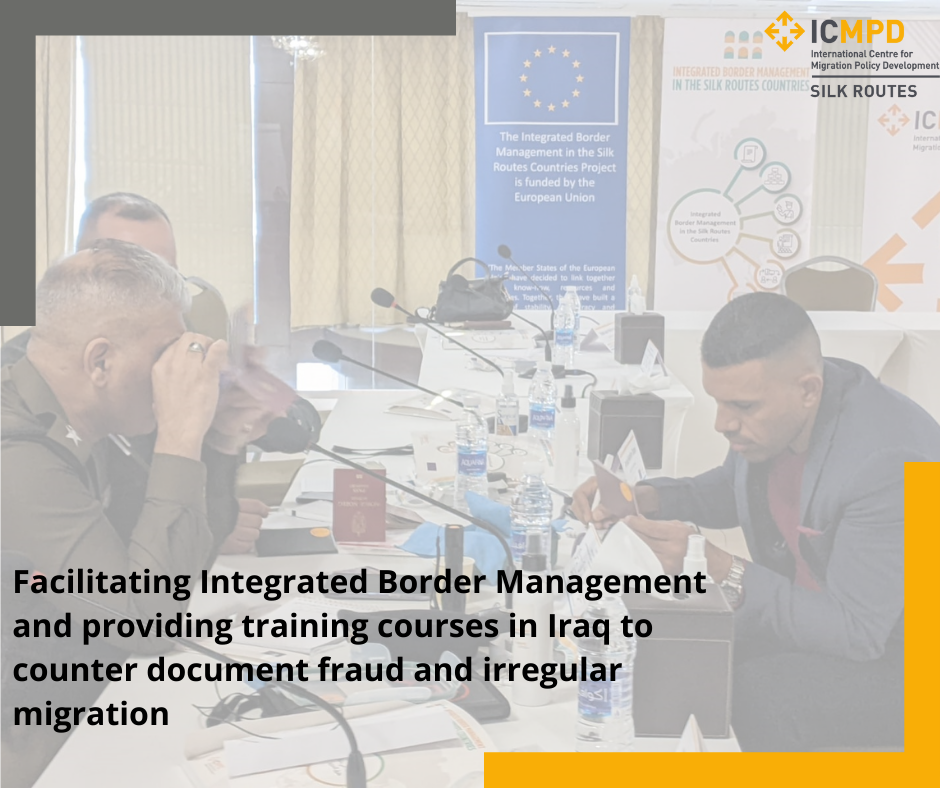
Baghdad, Iraq: A key priority area for ICMPD is Integrated Border Management (IBM), where the objective is to simultaneously enhance trade facilitation while ensuring a high level of border security. This requires cooperation and coordination between all actors involved in border management at the national and international level. It also needs concrete action in six fields: the legal and regulatory framework; institutional framework; procedures; human resources and training; communication and information exchange; and infrastructure and equipment.
Against this background ICMPD held Advanced Document Security training in Baghdad. This covered 22 border guards and officials in Iraq who successfully completed two advanced level training courses in Document Security and Identity in Baghdad between 5th – 14th December. This training was organised by ICMPD under the EU-funded IBM Silk Routes project.
The training equipped the officials – at the ranks of Colonel, Brigadier General, Major and Captain from the Ministry of Interior, Customs Police and Passport and Residence Department - with advanced technical expertise to detect falsified documents based on analysis of substrates, printing techniques and additional security features. Advanced tips for the profiling of travelers were also shared which will allow officials to identify suspicious travelers or impostors at border crossing points.
Officials from the Prime Minister’s office, Iraq Civil Aviation Authority and Border Port Commission also joined the training. The latest training event is the conclusion of an extended training programme that was running throughout 2021 which delivered basic and advanced training, as well as delivered train the trainers sessions, to serving officials at Iraq’s border crossing points.
This training is extremely timely since detections of irregular migration attempts at the EU’s external eastern borders from Iraq have increased significantly in 2021, primarily linked with the emergence of a new migration route into the EU via Belarus, with the majority of migrants originating from Iraq.
Furthermore, fraudulent documents, such as passports, visas, residence permits and identity cards, and the use of false identities are a well documented modi operandi used to evade detection at border crossings. The identification of techniques and attempts to evade detection and utilise fraudulent documents is therefore a core competence of front-line border guards to safeguard the security of the border and counter irregular migration and organised crime. The use of fraudulent documents facilitates irregular migration attempts and organised criminal activities such as migrant smuggling, trafficking in human beings, narcotic and weapon smuggling, as well as undetected cross-border movements by terrorist organisations. Strengthening the technical skills and knowledge of serving border guards to identify fraudulent documents through advanced training enhances the overall performance of the border agencies to interdict and counter these issues.